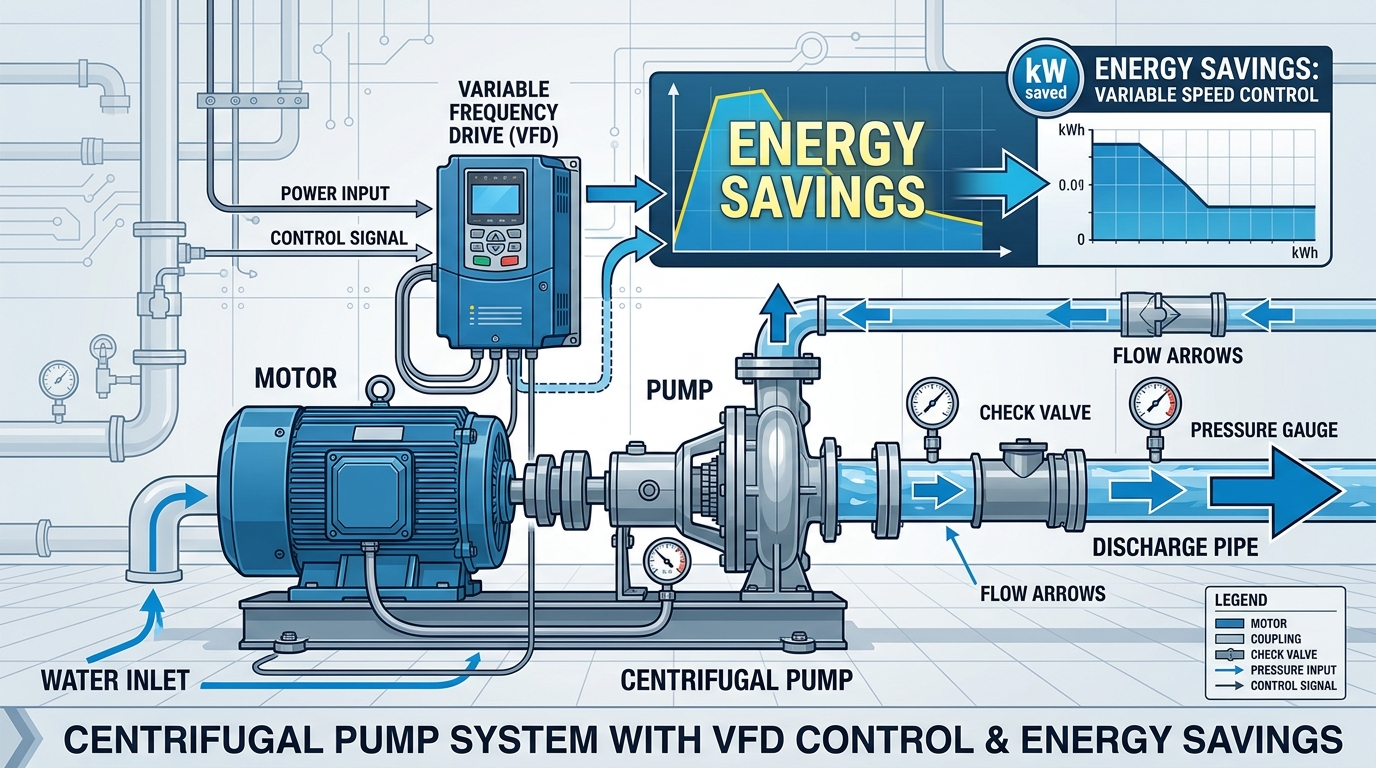
How to Select VFD for Pump Application: Step-by-Step Guide
Learn how to select the right VFD for pump applications in water/wastewater projects. Step-by-step guide covering sizing, torque, features, and ABB drive series for Indian engineers.
Selecting the right variable frequency drive (VFD) for a pump application is a critical decision that impacts system reliability, energy efficiency, and operational costs. Whether you are an engineer designing a water treatment plant or a procurement manager evaluating bids for a wastewater project, understanding how to select VFD for pump application correctly can save you from costly commissioning delays and performance issues. This guide provides a structured approach to choosing the optimal VFD for centrifugal pumps, covering everything from load characteristics to drive features and energy optimization.
Understanding Pump Load Characteristics
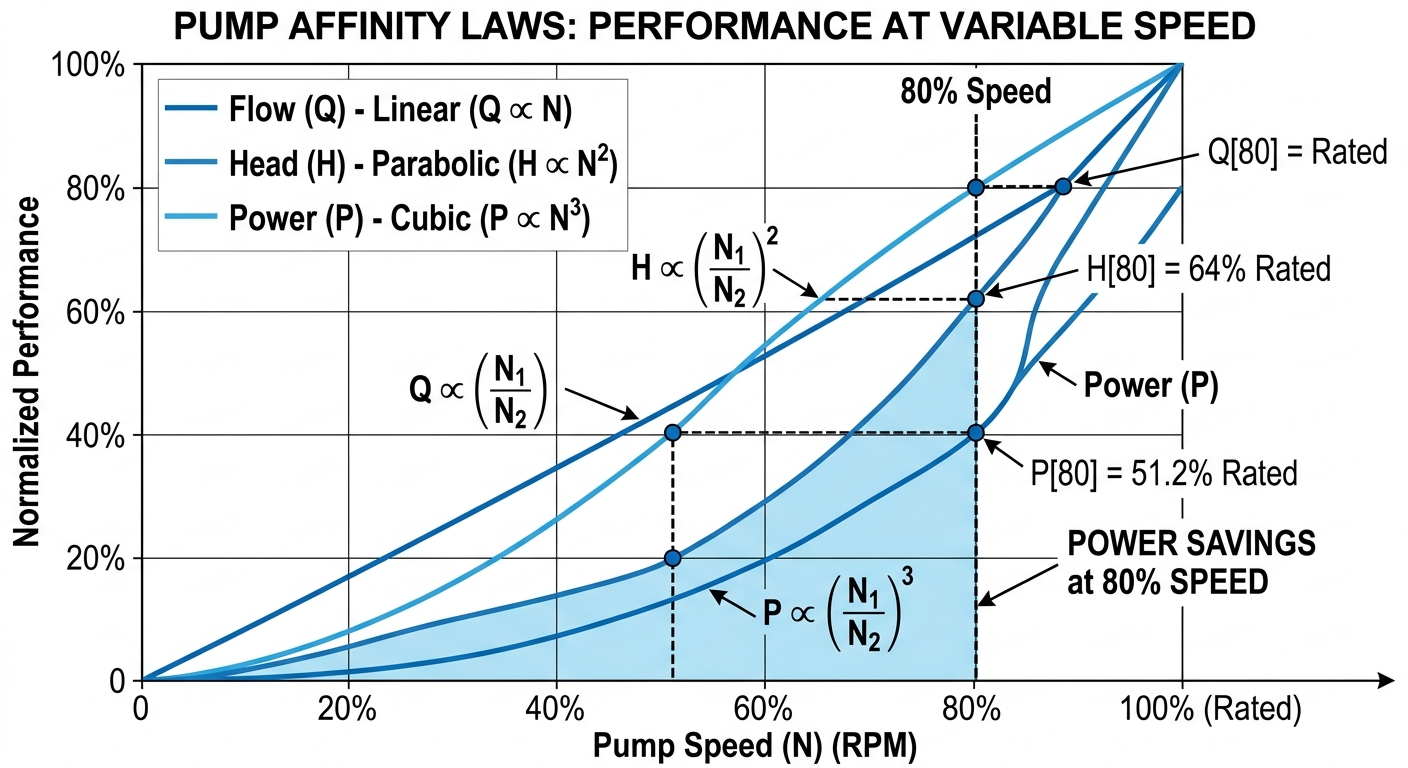
Pumps, especially centrifugal types, exhibit variable torque (also called quadratic torque) behavior. Unlike conveyors or crushers that require constant torque across the speed range, centrifugal pumps follow the Affinity Laws: flow is proportional to speed, pressure to speed squared, and power to speed cubed. This means that reducing pump speed by 20% reduces power consumption by nearly 50%. A correctly sized VFD exploits this relationship to deliver significant energy savings.
Variable Torque vs. Constant Torque
- Variable Torque (VT): Applies to centrifugal pumps and fans. Torque required increases with the square of speed. Most drive manufacturers label these as "Normal Duty" (ND) or "Variable Torque" applications.
- Constant Torque (CT): Applies to positive displacement pumps (e.g., screw pumps, diaphragm pumps) or conveyors. Torque remains constant regardless of speed.
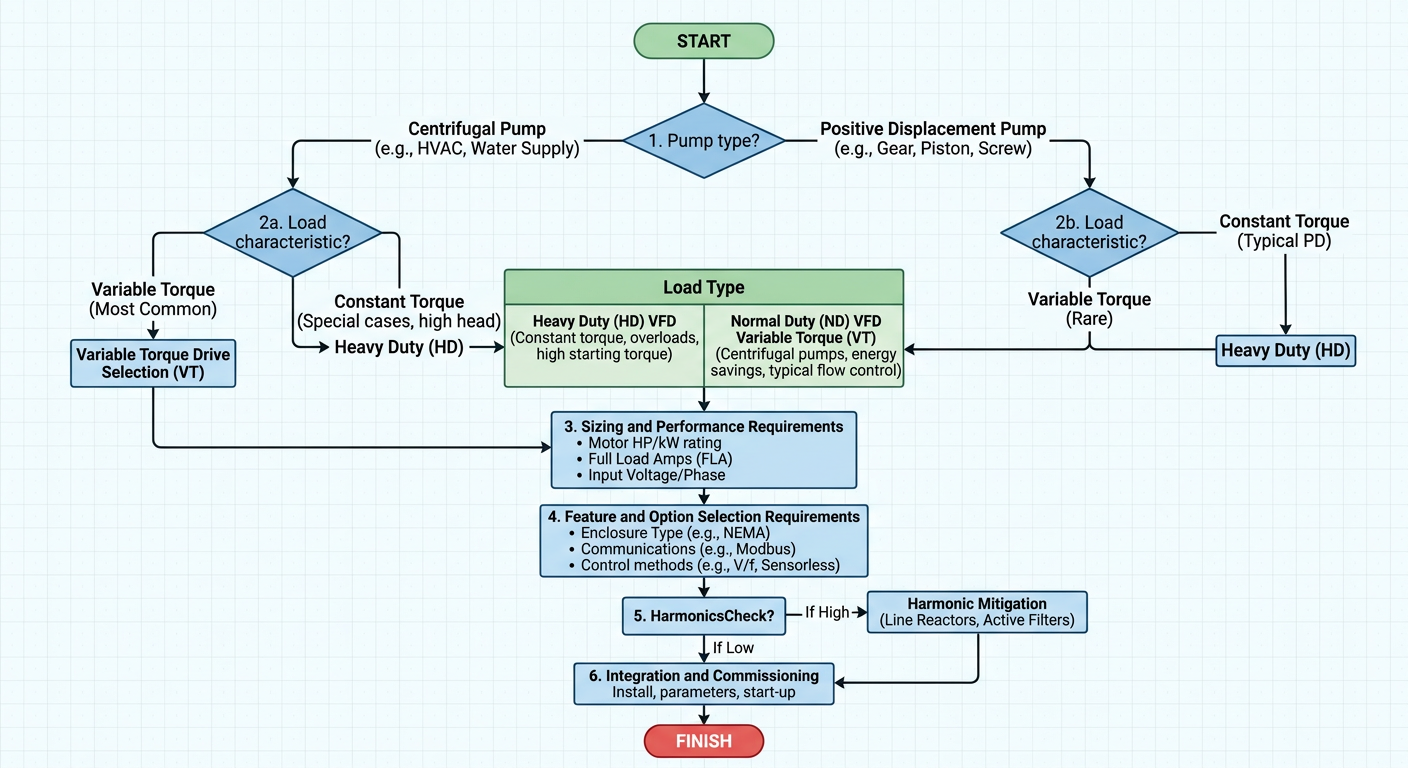
When you search for how to select VFD for pump application, the first checkpoint is identifying your pump type. A mismatch – using a constant torque drive for a centrifugal pump – leads to oversizing and unnecessary cost. Conversely, using a variable torque drive for a positive displacement pump can cause motor overloading at low speeds.
Step 1: Determine Motor and Pump Specifications
Start with the driven equipment data. Record the motor nameplate: full load amps (FLA), rated power (kW or HP), rated voltage, and speed (RPM). For the pump, obtain the rated flow, head, and the duty point. The VFD must be sized to handle the motor’s full load current, not just the pump’s absorbed power.
Sizing Rule of Thumb
- Select a VFD rated for the motor’s full load current at the applied voltage.
- For centrifugal pumps, you can usually select a Normal Duty (ND) rating that corresponds to 110% of the motor’s rated current for one minute (typical overload capability).
- If the pump operates near the motor’s full load continuously, consider a drive with a higher overload rating (e.g., 120% for 60 seconds) to ensure safe startup after a trip.
Oversizing Considerations
Oversizing a drive by one frame size is sometimes acceptable for future motor upgrades or to provide additional thermal margin, but it increases cost and panel space. Use ABB’s web-based drive selection tools (available through our AC Drives page) to automate this step based on your motor data.
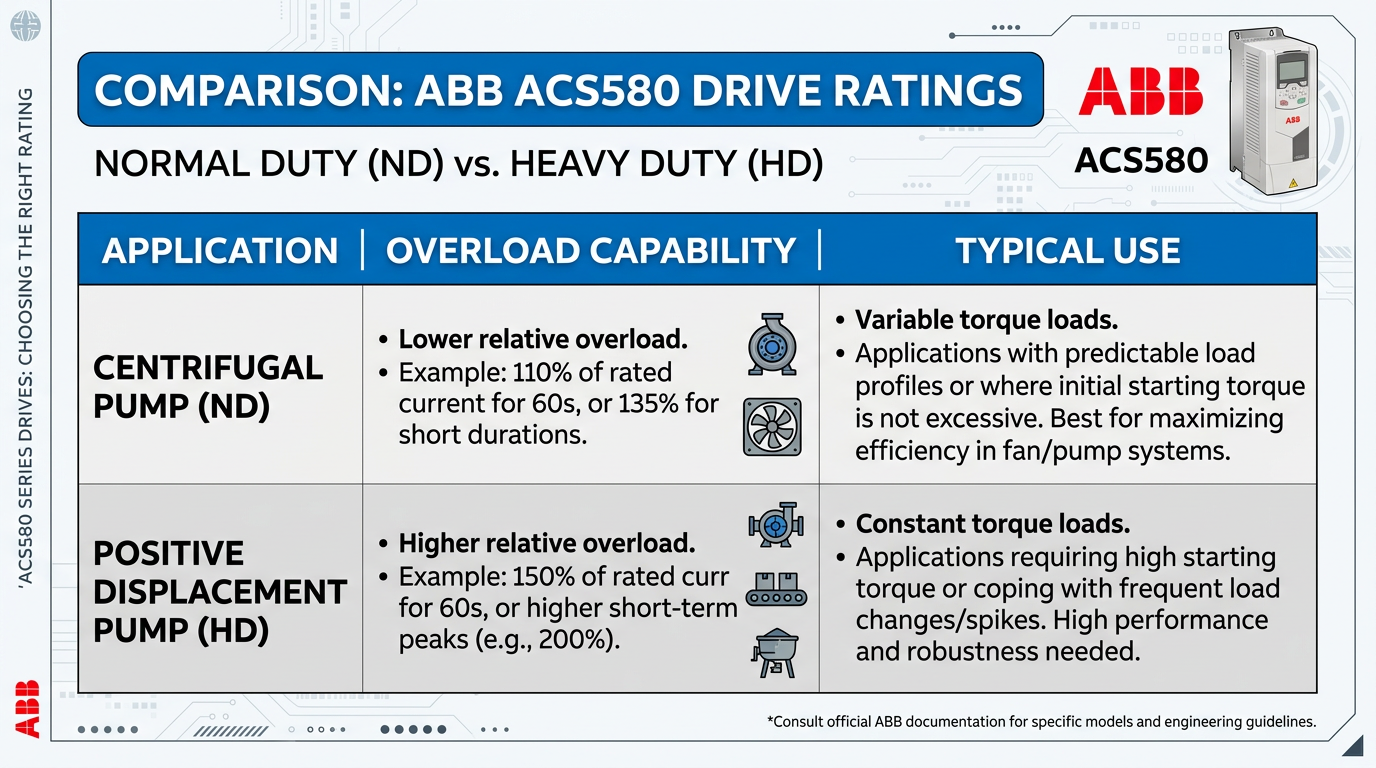
Step 2: Select Drive Rating – Normal Duty vs. Heavy Duty
Modern VFD families, such as ABB’s unified ACS series (ACS180, ACS380, ACS580, ACS880), clearly specify both Normal Duty (ND) and Heavy Duty (HD) current ratings. For pump applications:
- Normal Duty (ND): Suitable for centrifugal pumps with variable torque. The drive can deliver 100% current continuously and 110% for 60 seconds.
- Heavy Duty (HD): Required for constant torque loads or for pumps with high breakaway torque (e.g., slurry pumps). HD rating provides 150% overload for 60 seconds.
Most water/wastewater applications use ND drives. However, if your pump is a positive displacement type or if you need to handle frequent start/stops under load, opt for an HD-rated drive from the same series. The ABB product family simplifies this decision by offering consistent performance across the range.
Step 3: Choose Essential Features for Pump Control
Beyond basic speed control, modern drives include features that simplify pump system integration. When learning how to select VFD for pump application, prioritize these capabilities:
- Built-in PID Controller: Allows the drive to maintain constant pressure or level without an external PLC. ABB’s ACS580 includes a dedicated pump PID with sleep/wake functions.
- Flying Start (Catch a Spinning Motor): Essential for pumps that may spin backward due to backflow. The drive must identify motor speed and direction before restarting to avoid overcurrent trips.
- Multi-pump Control: For systems with multiple pumps in parallel, a drive with built-in pump sequencing (e.g., ABB’s ACS880 with multi-pump program) can balance run hours and automatically stage pumps.
- Communication Protocols: Modbus RTU, BACnet, or Profibus for integration with plant SCADA. The Variable Frequency Drive page details communication options.
Avoid Feature Overload
Do not select a drive with unnecessary built-in PLCs or advanced safety functions if your pump loop is simple. For most municipal water projects, a standard ACS580 with a PID card and basic I/O is sufficient. Complex features add cost and commissioning time.
Step 4: Consider Harmonics and Power Quality
Pump drives, especially in large installations, can inject harmonic currents into the plant grid, causing transformer overheating and nuisance tripping. In Indian power distribution networks, total harmonic distortion (THD) limits are enforced by utilities. Two solutions are common:
- DC Chokes / Line Reactors: Standard in most ABB drives, they reduce THDi to around 30–40%.
- Active Front Ends (AFE) or 12/18-pulse Drives: For large pumps (>200 kW) in sensitive environments, ABB’s ACS880 with ultra-low harmonic option (ACH580) can achieve <5% THDi.
For most water/wastewater projects with dedicated transformers, a 3% line reactor plus the drive’s built-in DC choke is adequate. If your plant has sensitive loads nearby, evaluate the ACH 580 Ultra Low Harmonic Drives for clean power.
Step 5: Evaluate Energy Efficiency and Lifecycle Cost
How to select VFD for pump application ultimately hinges on total cost of ownership. The purchase price of a drive is often less than 20% of its lifetime cost. Focus on:
- Efficiency at Partial Load: Look for drives with >97% efficiency and motor drive packages that optimize energy usage. ABB’s SynRM (synchronous reluctance) motors paired with the ACS880 can achieve IE5 efficiency levels.
- Energy Save Modes: Built-in functions like “Energy Optimizer” in ABB drives automatically adjust flux to match load, reducing losses at low speeds.
- Pump Affinity Law Savings: A typical example: running a 75 kW pump at 80% speed reduces power to 38.4 kW (saving 36.6 kW). At ₹8/kWh and 6000 hours/year, that is over ₹17 lakhs annually in electricity savings.
Our Services team can run a payback analysis for your specific pump system, factoring in drive cost, installation, and expected kWh savings.
Step 6: Integration with Control Systems and Panels
A VFD is only a component of the larger pump control system. Ensure the drive can communicate seamlessly with your PLC (Programmable Logic Controller) and the PLC ecosystem used in your plant. Common integration points:
- Control Panel Layout: The drive should fit within the existing control panels or be ordered as a pre-configured package. ABB offers drives with built-in disconnect switches and EMC filters.
- Commissioning Support: Local technical support for parameter setup and pump start-up is invaluable. Digital Controls provides on-site commissioning and application review for time-sensitive projects.
- Retrofit Considerations: If replacing an existing starter or older drive, check physical dimensions and cable terminations. ABB’s ACS180 is a compact option for retrofit into tight spaces.
Frequently Asked Questions
1. Can I use any VFD for a pump? No. Pumps require drives rated for variable torque loads (Normal Duty). Using a constant torque drive may work but increases cost. Always verify the drive’s overload capability matches pump starting requirements.
2. How do I size a VFD for a pump? Size the drive based on the motor’s full load current, not the pump power. For centrifugal pumps, select a Normal Duty drive with a current rating equal to or greater than the motor FLA. Use the drive manufacturer’s selection tool for exact sizing.
3. What is the difference between Normal Duty and Heavy Duty in ABB drives? Normal Duty (ND) offers 110% overload for 60 seconds, suitable for centrifugal pumps. Heavy Duty (HD) offers 150% overload for 60 seconds, needed for positive displacement pumps or high-torque applications.
4. Do I need a harmonic filter for my pump VFD? It depends on the total harmonic distortion allowed by your utility and the sensitivity of nearby equipment. Most small to medium pumps with a line reactor are sufficient. For large pumps (>100 kW) or critical installations, consider low-harmonic drives like ABB’s ACH580.
Conclusion
Selecting the right VFD for a pump application does not have to be complex. By understanding the pump’s load characteristics, sizing the drive correctly, choosing essential control features, and considering harmonics and energy efficiency, you can ensure a reliable and cost-effective solution. The ABB drive family offers a scalable path from simple fixed-speed replacement to advanced multi-pump energy optimization. For hands-on application review and drive selection support, contact our team at Digital Controls. We help Indian engineers and procurement teams navigate how to select VFD for pump application with confidence. Visit our Solutions page to explore typical configurations, or Enquire directly for a custom proposal.