Project Story
Driving Productivity & Efficiency with ABB Automation
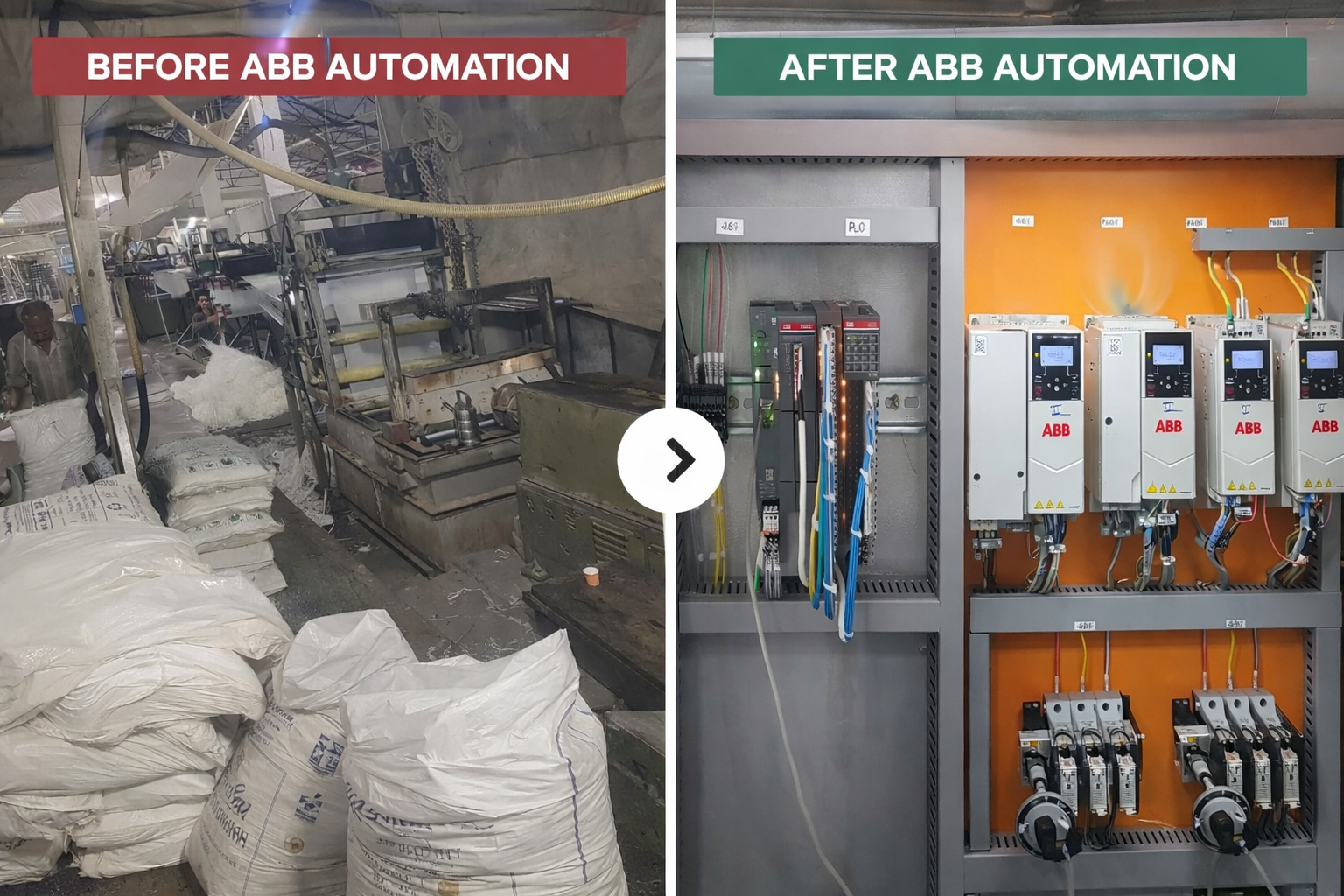
By implementing an ABB PLC-based automation system with AC drives and motors, the production line was transformed into a highspeed, reliable, and energy-efficient system, delivering measurable improvements in productivity, quality, and operational cost.
Sucess story
Transforming a Stretch Film Manufacturing Plant Through Smart Automation Industry: Flexible Packaging (Stretch Film Manufacturing)
1. Executive Overview
In today’s competitive manufacturing landscape, operational inefficiencies are no longer just a cost burden—they directly impact scalability, consistency, and market positioning.
A leading stretch film manufacturing industry approached us with a critical challenge: their production line was heavily dependent on outdated systems, manual intervention, and inefficient energy consumption. These limitations were not only restricting output but also increasing operational risks.
Within a tight 2–3 day execution window, we successfully transformed their conventional extrusion system into a fully automated, intelligent, and high-performance production unit—delivering measurable improvements across efficiency, quality, and cost.
2. The Challenge: Where the System Was Failing
** The existing setup relied on DC drives, DC motors, and relay-based control systems, which created multiple bottlenecks:
High Operator Dependency Manual synchronization led to frequent film breakages and inconsistent output. Frequent Breakdowns & Downtime Relay logic and electromagnetic components required constant maintenance, resulting in production interruptions. Inconsistent Product Quality Lack of precise speed control caused variations in film thickness and surface finish. Excessive Energy Consumption DC motors and outdated control systems consumed significantly higher power. Time-Critical Upgrade Requirement The entire system overhaul had to be completed within 2–3 days, without impacting business continuity.
3. The Solution: Intelligent Automation with ABB Technology
We designed and deployed a next-generation automation architecture built on reliability, precision, and scalability.
Key Components Implemented: PLC-Based Central Control System Enabled real-time decision-making and closed-loop control across the entire process. AC Drives (VFDs) with AC Motors Replaced inefficient DC systems, ensuring smooth, precise, and energy-efficient operations. Advanced HMI Interface Provided operators with full control—real-time monitoring, parameter setting, and instant diagnostics.
4. Execution Excellence: What Made This Transformation Powerful
This was not just a hardware upgrade—it was a complete process transformation.
Highlights: Multi-Motor Synchronization Seamless coordination of 5 motors ensured consistent film tension, virtually eliminating breakages. Process Automation Manual intervention was replaced with intelligent control logic, reducing human dependency drastically. Real-Time Monitoring Operators gained visibility into temperature, speed, and system health—enabling faster decision-making. Enhanced Safety Systems Automatic shutdowns and emergency responses improved operational safety standards. Rapid Deployment Full system modernization completed within 2–3 days, minimizing production loss.
5. Measurable Impact: From Inefficiency to Exponential Growth
The results were not incremental—they were transformational.
Key Performance Improvements:-
Scrap Reduction:
Reduced from ~5% to less than 1.5% → Significant material savings and improved yield
Energy Savings:-
~18% reduction in electricity consumption → Direct impact on operational cost
Downtime Reduction:-
~40% decrease in machine downtime → Increased production availability
Quality Consistency:
Highly uniform film thickness and superior surface finish → Enhanced product reliability and market competitiveness
6. The Bigger Picture: Beyond Numbers
This project demonstrates what happens when automation meets strategic execution:
Energy Efficiency → Lower Cost → Higher Profitability Process Automation → Reduced Dependency → Faster Output Consistency → Better Quality → Stronger Market Position Reduced Downtime → More Production → Scalable Growth
In simple terms, the plant transitioned from a manual, reactive system to a smart, predictive, and high-performance operation.
7. Conclusion: A Shift from Survival to Scalable Growth
The modernization of this stretch film manufacturing unit is a clear example of how technology-driven transformation can unlock exponential value.
What started as a need to fix inefficiencies turned into:
Faster production cycles Lower operational costs Improved product quality Reduced human dependency And a clear path toward scalable growth
This is not just an upgrade—it’s a complete evolution of the manufacturing ecosystem.